
As Friederike herself puts it, when she believes in something passionately, she’s “like a dog with a bone.” Having joined Pilgrims’ Friend Society in 2022, she is dedicated to ensuring that across our homes older people continue to live as fulfilled lives as possible. Of the 350 or so people who live in our care homes, a high proportion are living with a form of dementia – whether officially diagnosed or not – and so ensuring our teams are equipped to care for them really well is key.
In her role as Operations Manager and overall The Way We Care Lead, Friederike regularly travels to our homes to deliver training sessions and work closely with our Wellbeing & Dementia Leads, the staff members who oversee our approach to care in our homes day-to-day.
“One quote I always share during training is ‘people with dementia are doing the best they can’,” says Friederike. “It comes from a dementia expert called Teepa Snow. I think once you see people with dementia in that light you can have compassion, and then you strive for excellence because you really want to get it right for that person.”
This compassionate response involves taking the time to get to know a person. “In adult social care, people used to talk about ‘person-centred’ care,” says Friederike. “Now they are starting to use the term ‘relational care’. I think that’s a better term as good care is all about building relationships. When a person has dementia, they may struggle to communicate their needs and wishes. The better you know that person, the more likely you are to be able to work out what it is they need to flourish and enjoy life.”
This desire to make things the best they can possibly be for those facing need, while at the same time rallying others, has been evident throughout Friederike’s working life. After finishing school, she trained as a nurse at a hospital run by Lutheran sisters in Rotenburg an der Wümme in her native Germany. She then went to work in Botswana for a year, an experience that fuelled her interest in women’s health and childbirth and led her to go on and train as a midwife in the UK. While a midwife, she began training others, and even ran her first antenatal group while pregnant with her first child. She was also seconded as the ‘Stop-Smoking Midwife’ for Bath, working with pregnant smokers and their partners to reduce smoking in pregnancy.
Friederike reflects, “If you need me to get passionate and interested in something, I will, but only if I’m convinced it’s right”.
After 18 years in midwifery, and with a growing interest in public health and health promotion, Friederike decided to do additional training in Specialist Community Public Health, becoming first a health visitor and eventually a team leader, responsible for compliance, supervisions, quality assurance and audits across the service.
As Friederike approached 35 years with the NHS, she felt it was time for a change. She saw the role of care manager advertised at our care home Middlefields House in Chippenham and decided to apply. At interview, it was clear to the team that her skillset and commitment to excellence would make her an asset to our Operations Team, and she was offered a role as Operations Manager. Shortly after joining us, Friederike was given the title of Queen’s Nurse, a prestigious award that recognises those who ‘are dedicated to improving healthcare standards and supporting patients, families and communities.’

As well as bringing a wealth of professional expertise, Friederike’s personal experience of supporting her mother-in-law with dementia also helped prepare her for a role in the care sector.
“My first real encounter with someone living with dementia was my mother-in-law, actually,” Friederike reflects. “It is not because of my mother-in-law I knew I wanted to go into older people’s care, but I can definitely see how the Lord has used the experience.”
Walking the path as a relative helped build her sense of what the different stages of may look like, and what a family may go through emotionally.
For Friederike and her family, concerns began when her mother-in-law moved into a flat some years after her husband died. “My mother-in-law was very independent, but then she started to do things like lose her keys. She’d call her neighbours in a panic and then they’d help her and find the keys in the handbag after all.”
Friederike recalls how her mother started to write down everything meticulously, amassing notebooks of lists. “Knowing what I now know about the stages of dementia I think this was her way of trying to keep on top of everything,“ she reflects. “At some level, she knew something wasn’t right, and so she was working hard to compensate for it.”
As time went on, concerns grew and eventually her mother-in-law moved to care home, where, after going initially for respite care, she settled in well.
One the biggest things Friederike takes away from this time, and that she is most keen to impress upon others, is that for people with dementia, life goes on. “Life doesn’t stop just because you have dementia. People with dementia need to do normal things. It’s about creating those moments,” she says. “Some of the fondest memories I have of my mother-in-law are from when she was living at the care home.”
While her mother-in-law was in the home, Friederike and her husband would make the drive up from Bath to visit her every fortnight and take her on all sorts of outings – to evensong and concerts, because she loved music and singing, or to am dram performances in the park with a picnic. Another favourite trip was to the local botanic gardens where her mother-in- law loved to ‘go and see the carrots’.
“They aren’t really carrots at all, but the goldfish in the ponds,” Friederike explains. “Her children called them that when they were little and the name stuck.”
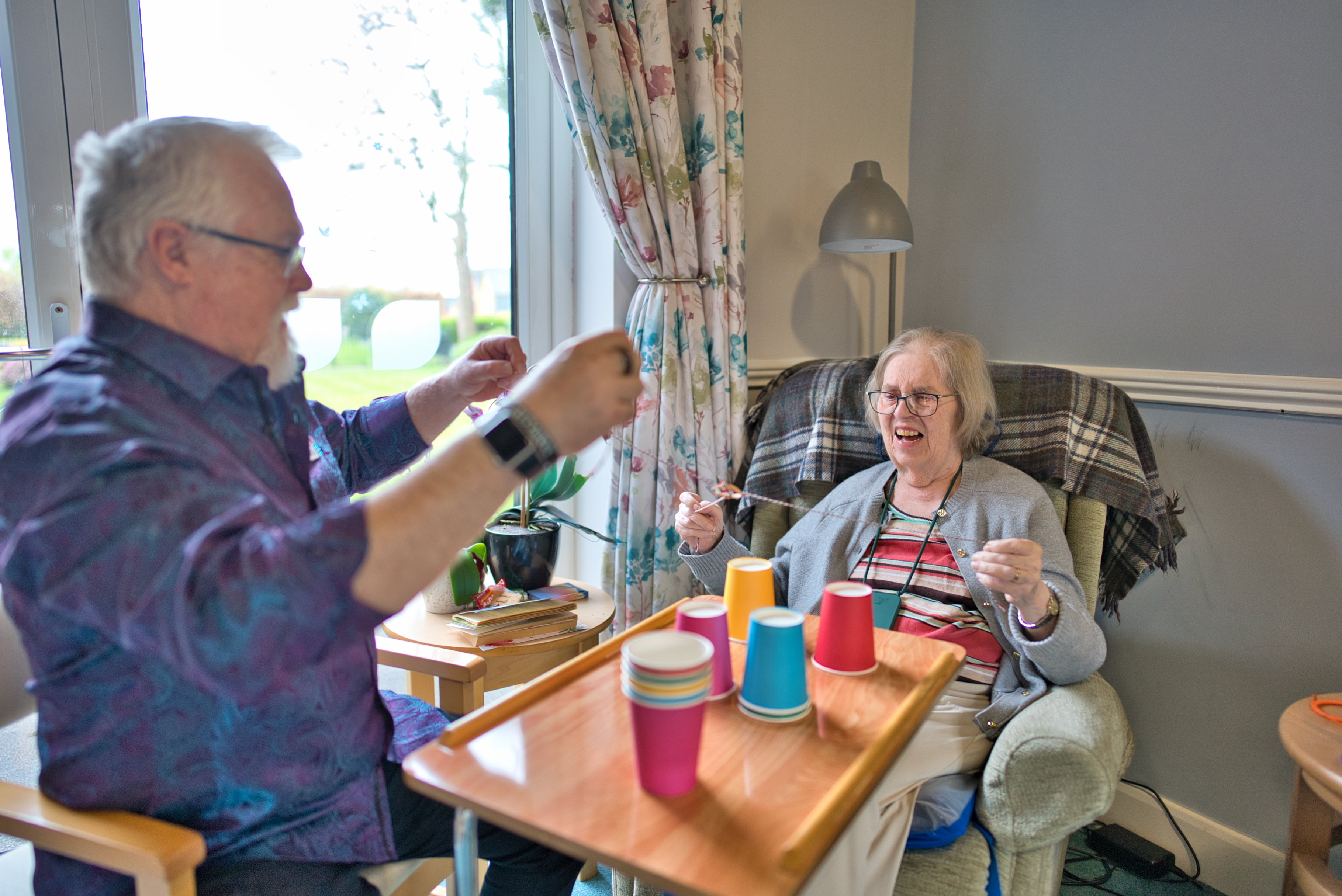
Friederike’s mother-in-law passed away peacefully in February 2021. Friederike and her husband were able to be with her during those final days, singing to her by her bedside. “Even at that stage, she was able to join in. Not singing, necessarily, but humming along.”
With this experience behind her, Friederike is committed to ensuring that the loved ones of those with dementia are also supported. “It can be a bewildering time, especially if you don’t know much about dementia already.”
At Pilgrims’ Friend Society, we have a range of resources available to support those facing this situation. Friederike recommends our resource Dementia: Pathways to Hope by Louise Morse, recalling how she and her husband came across it and how for her husband especially it proved invaluable in building understanding.
As part of The Way We Care, Friederike has also worked with our homes in setting up Family Matters groups. Led by our Wellbeing and Dementia Leads, they are places where family and friends of those with dementia can learn more about how their loved one may be affected, and also come alongside others who are having similar experiences.
“Relationships are important to us all,” says Friederike. “That’s why it’s so vital for relatives to have that understanding, to feel confident around their loved one with dementia and to draw on the support of others through the community of our homes. Dementia can be a cruel disease, but with the right support, a person with dementia, and their loved ones, can live well.”
Related articles
All articles
Lifting the lid on memory boxes
Read more

Meet a Hummingbird... Susan
Read more

Discipleship that sustains
Read more